Why do parts of England and Wales keep falling into drought?
More than half of England and the whole of Wales has been declared to be in drought this week - the third such event over the past five years.
More than half of England and the whole of Wales has been declared to be in drought this week - the third such event over the past five years.
Farmers have described suffering from reduced yields and being forced to harvest earlier, and field fires increasing.
The drought comes despite winter bringing above average rainfall, and reservoirs still close to expected levels for this time of year.
So why are parts of the country struggling to get hold of water?
There is no single definition of drought, according to the Environment Agency (EA), it depends on who is impacted, the availability of water and its use.
A drought can affect things including the environment, farming, or the water supply - what response the government and industry take depends on what the drought is affecting.
Possible measures include rescuing and relocating fish, increased business checks on water usage, and redistribution of water supplies.
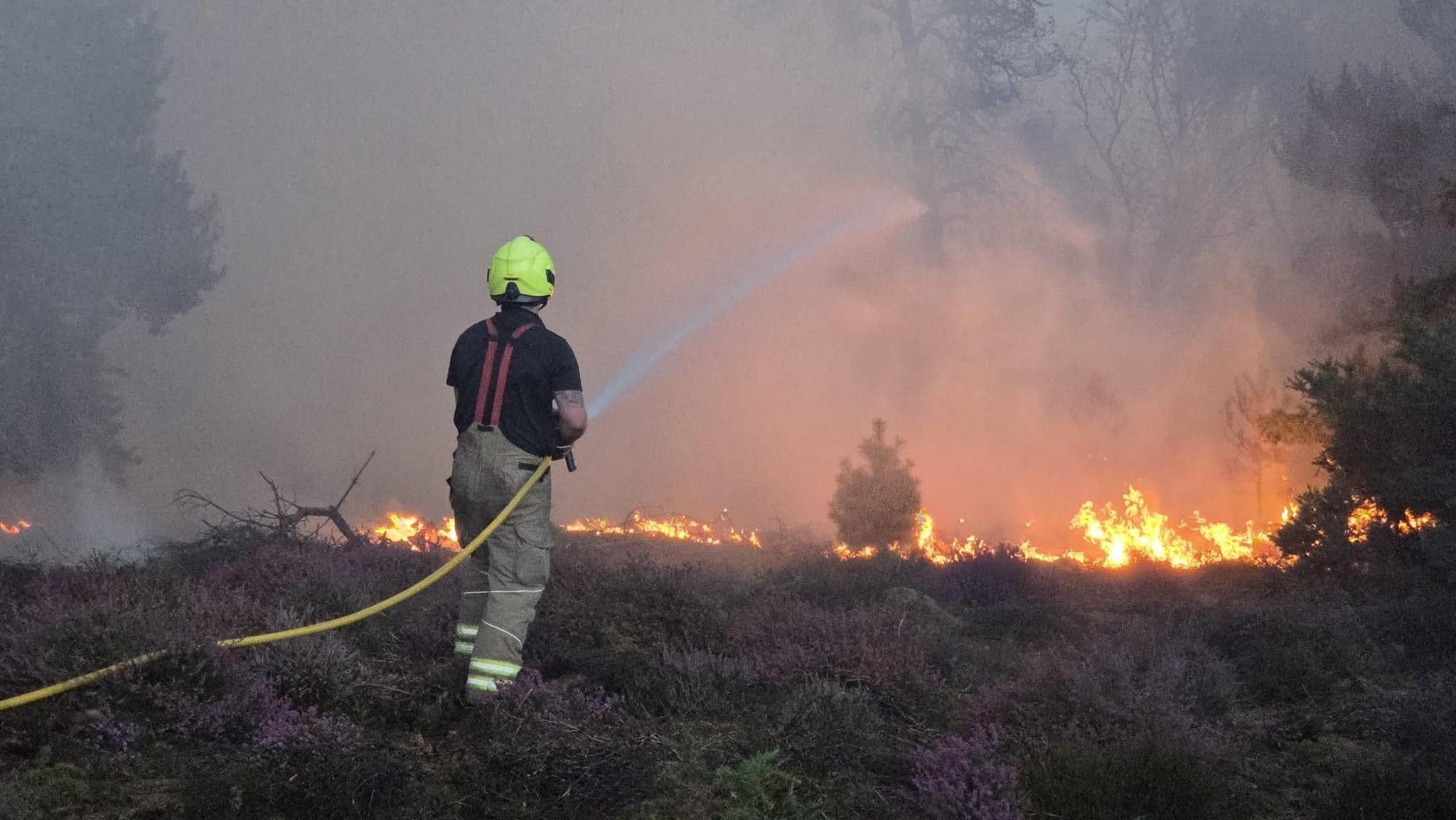
Image source, Suffolk Fire and Rescue Service
Image caption, A firefighter talks a huge blaze on Dunwich Heath, Suffolk which has caused thousands to be evacuated from their homes

But currently, nearly all water companies are at drought level 1 - Anglian is the exception at 2 - out of a possible maximum of 4.
It is rivers and groundwater levels which have been significantly impacted by a sudden drop in rainfall.
South East England relies more heavily on groundwater - where rainfall is stored beneath the surface in pore spaces and fractures in the rock.
Chalk areas across the country - from the Yorkshire Wolds to the Wessex Downs - are all reporting levels either at expected or below normal for this time of year, with the Cotswolds particularly struggling.
But these groundwater stores "respond more slowly to changes in the climate than rivers, which is why they provide a useful buffer during periods of drought", said Prof Alan MacDonald of the British Geological Survey.
Wales has received just 8% of its average rainfall so far this month. England has received 7% of its average, with that figure as low as 1% across southern England. Therefore, groundwater levels are expected to drop even further still.
The low rainfall and high temperatures, which increase evaporation rates, have hit rivers hardest.
The EA said nearly 80% of England's rivers are seeing flows below normal or lower - the River Thames at Reading has recorded its lowest level on record.
Farmers source water for their crops and livestock over summer from a combination of stored winter rainfall on site, and by extracting it from natural sources - a process called abstraction.
This can be from groundwater or from surface water, like rivers and streams. So, as levels drop, this becomes a serious issue.
Eleanor Gilbert told Radio 4's Today programme that the hot weather has been "very tough" on her farm in Berkshire, which has recorded "less than 30mm of rain since the end of March".
Moisture content has to be at a specific level for harvesting different crops.
Gilbert said they have been harvesting at 03:00 BST to bring the moisture up, as at that time of day it's cooler and water condenses.
But the dry conditions caused by the hot weather have prevented the grain from swelling. It means the farm's yield is down to almost half of what it was the previous year.
The EA and Natural Resource Wales grant abstraction licences to farms, but when water levels drop they can impose what is called a "hands-off flow restriction".
This means farms are prevented from abstracting water, this is to protect the environment.
There are currently 1,353 of these restrictions in place. The EA has also warned that voluntary restrictions may be put in place next month - when farmers are asked to reduce their volumes of water use, only irrigate at night or on certain days of the week.
Ben Andrews, a mixed organic farmer in north Herefordshire, told BBC Radio 4's Today programme that he has had an abstraction licence restriction since the start of the month.
"We will have paid for the plants, paid for the labour, if we don't get to pick any of them then it's investment that's lost."
Even with these measures in place there have been 61 environmental incidents due to the drought, such as reported fish deaths which, although lower than last year, are rapidly increasing and thought to be underestimated. , external
Climate change is raising global temperatures, which in the UK is expected to lead to drier summers and more intense and longer lasting heatwaves - both of which could contribute to lower river and groundwater levels.
On Wednesday, the National Drought Group - which includes regulators, the government, the Met Office, water companies, farmers, the Canal & River Trust, anglers and conservation experts - held a briefing with Water Minister Emma Hardy.
The Department for Environment Food and Rural Affairs (Defra) said the group reviewed the impact of the drought in England, the country's preparedness and response to it.
Hardy said: "We're delivering long-term change in the water industry and driving record investments in infrastructure, including nine new reservoirs.
"We expect water companies to follow their drought plans, to go further and faster to reduce leaks, and to ensure supplies are not disrupted even in the driest of weather."
"We need to invest for the long term, in new water storage facilities, whether it's at the local level supporting farmers or at a large scale with the water companies themselves being allowed to build reservoirs," Sir John Armitt, former chairman of the National Infrastructure Commission, told Radio 4's Today programme on Thursday.
He said for a long time governments have resisted building new reservoirs on the basis other solutions could be found, but the recent weather extremes the UK has been experiencing "have really caught people out".
There has been no major reservoir completed in England since 1992. Sir Jon Cunliffe, former Bank of England deputy governor, reviewed the sector last year and concluded that there had been "underinvestment" - blaming both the water industry and regulators.
Sir John Armitt also said that the industry must also tackle leakage and usage.
"That's beholden on all of us to try to reduce the amount we use, and we could save a similar amount if we could get down to the levels of Denmark who use about 100 litres per person a day."
The average use per person in the UK is around 140 litres.
Water UK, which represents the industry, said at the time, in response: "Everyone agrees the system has not been working.... fundamental change has been long overdue."
There are currently two reservoirs pencilled for completion in 2036 and the 2040s, and more set to be approved.
In May last year, the government said that water companies had committed to bringing nine new reservoirs by 2050.
They would be located in Lincolnshire, Cambridgeshire, Oxfordshire, Somerset, Suffolk, Kent, East Sussex, and the West Midlands.
The government said that these reservoirs have the potential to provide 670 million litres of extra water per day.
Additional reporting by Tom Ingham, Charlotte Hadfield and Ella Kipling.
Originally published by
BBC News
Aggregated from a public feed. Read the original at the source for the publisher's full presentation.
View original on bbc.co.ukContinue reading